When Penguin was born, I promised to show you the world through stories and small adventures. Not just books. Not just screens. Real places. Few wanderings, temples, forests, and every little discovery that stitched meaning into life.
Over the years, our Sundays became tiny adventure. Tiny journeys. Some days we read together. Some days we visited a temple or walked by a lake. And on many days, Penguin’s endless questions pushed me to learn things I had never explored before.
Whenever Penguin missed a trip, I wrote him a letter. So that one day he could read it all and remember how our curiosity grew together.
Dear curious penguin,
Sunday mornings used to be slow. You woke up late. Skipped breakfast. Ate a heavy brunch. Watched Netflix. And stayed on the couch for hours.
But after we moved to Bhubaneswar, things changed. This city has too much history to let us stay lazy. It keeps pulling us outside. And now that you enjoy sports, our Sundays move even faster.
Do you remember our 2022 visit to Sureswari Temple in Sonepur? You were six then. You were drawn to the icons on the walls. That day was also our first long talk about Shakta traditions. Before that, you only knew a little about Shiva, Vishnu and Buddha.
I could not answer all your questions back then. I still cannot. Odisha’s Shakta culture is big and deep. I am still learning.
Recently, I got a chance to seek the blessing at the Tini Mundia or Vaital (Baitala) Deula Temple. You could not come. I do not know when we will get another chance to go together. So, I am writing this for you.
How old are you now? I do not know. But when you were six, you were full of strange, beautiful questions. You wanted to know about Adishakti, Tridev, devtas, gandharvas and more.
We started reading the Ramayan when you were three. We are still discussing it today (Now you are 9). We went through Valmiki, Bichitra, Kakbhushundi, and many movies and shows.
You helped me discover new characters too. Like Swayamprabha.
But Shakta stories still remain unexplored for us.
Do you remember Raktabīja? The demon who created his own clone from every drop of blood. When we spoke about Ravana, you always asked, “Was he a good king?” You may ask the same here.
Raktabīja was fast, strong and feared by all. No one could defeat him. So, the gods prayed to Maa Parvati. She took the form of Maa Durga. She fought hard. But every time she hurt him, many new demons rose from the drops of his blood.
Then Durga created the Matrikas. Each Matrika came from a major deity, Brahmani (Brahma), Vaishnavi (Vishnu), Maheshwari (Mahesh/Shiv), Indrani(Indra), Kaumari (Kartikeya), Varahi (Varaha), Chamunda, Narasimhi (Narashimha) and Vinayaki (Vinayaka). Among them, Maa Chamunda was different. She was not the shakti of a male god. She was Devi’s own fierce power. She spread her long tongue across the battlefield. Every drop of blood fell on it. Nothing touched the ground. She swallowed every clone of Raktabīja and ended him.
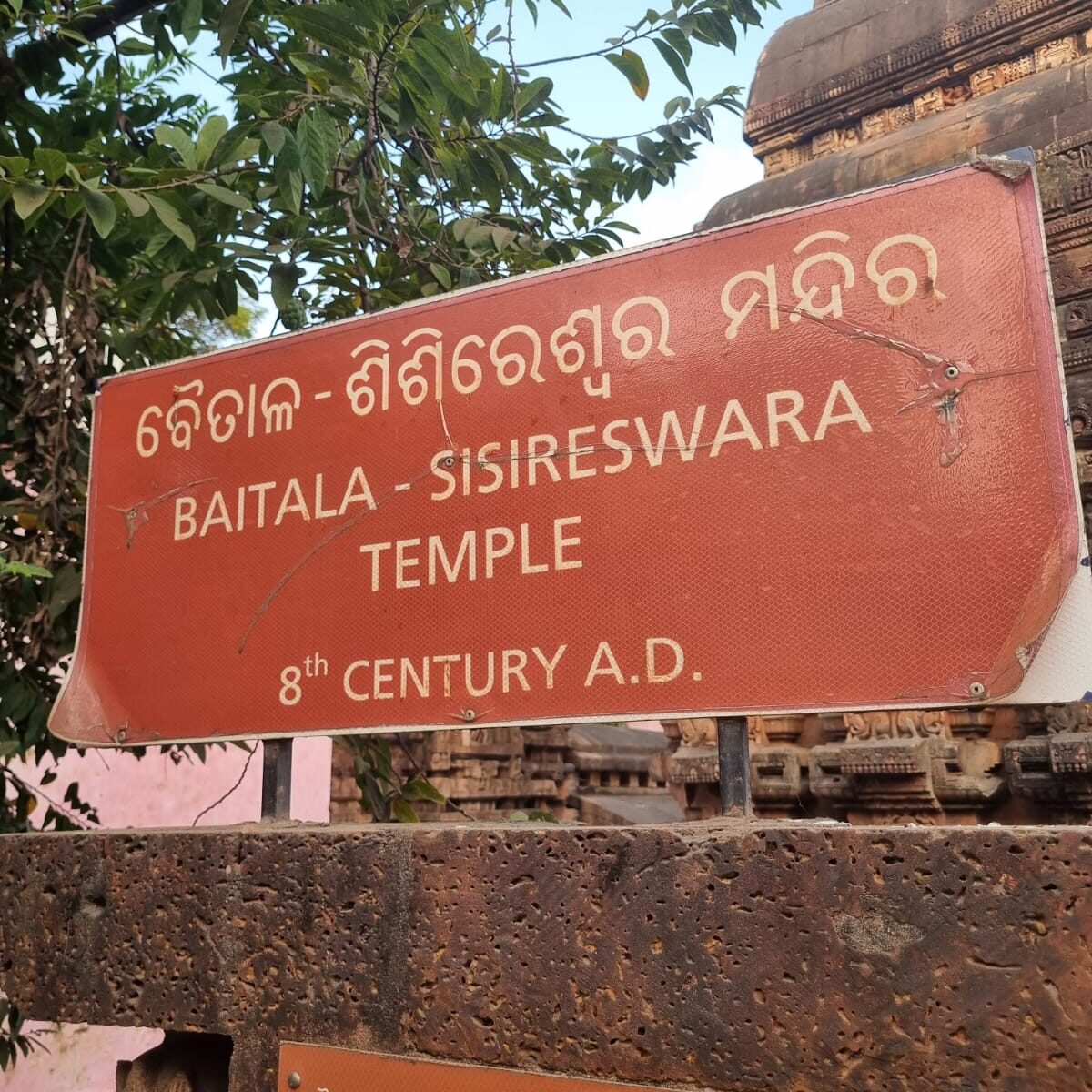
This temple in Bhubaneswar is dedicated to Chamunda. It was built in the 8th century by Queen Tribhuvana Mahadevi of the Bhaumakara dynasty.
People say the name “Vaital” may come from
- Vahitra (ship), because the top looks like an upside-down boat.
- Vaita Kakharu (pumpkin), the local name.
- Vetala (spirits), linked to old tantric practices here.
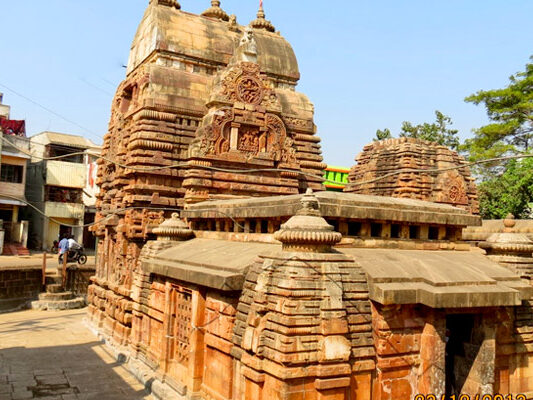
The temple has a special Khakhara style. The tower is rectangular. Three kalash sits on top. They represent Mahakali, Mahasaraswati and Mahalakshmi.
Inside, Chamunda sits on a corpse. She wears a garland of skulls. An owl and a jackal stand nearby. She holds many weapons. Her eyes are covered with silver. The sanctum has 15 strange figures carved around her.
Outside, there are beautiful carvings of the Sun God, his wives, and a ten-armed Nataraja.
Next to it in the same compound is the Sisireswara Temple (Terribly encroached). Both temples stand by Bindu Sagar, the lake we visit every Kartik Purnima.
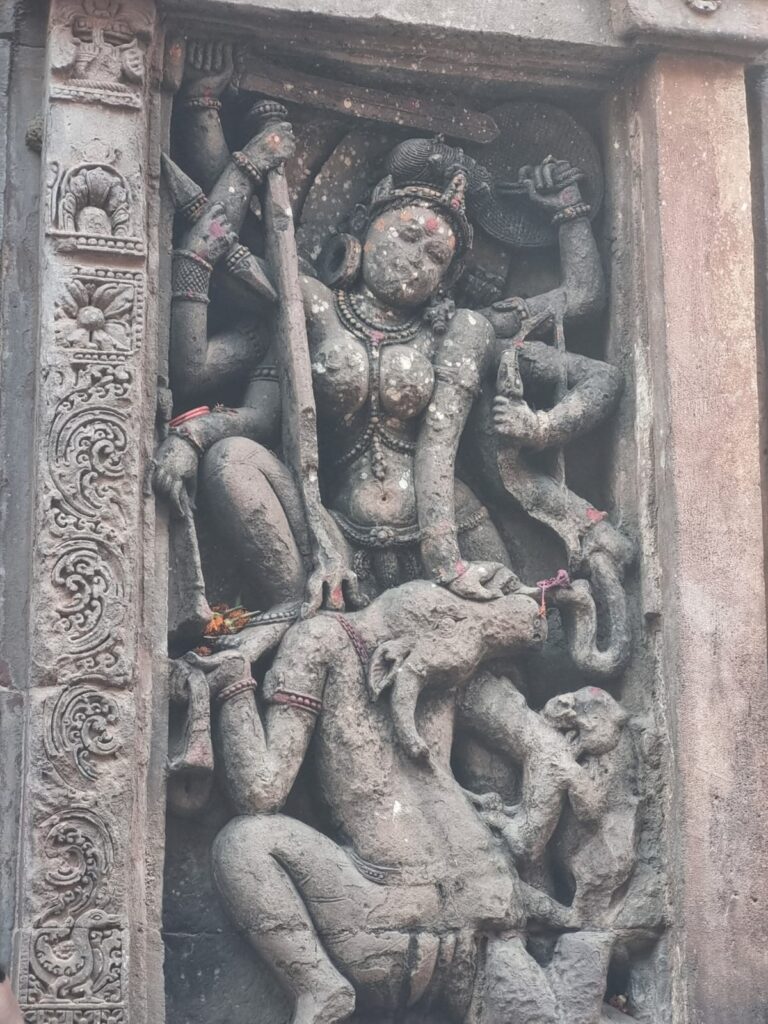
One of the most striking figures was the Mahishamardini. During Durga Puja, we usually see a calm, victorious Durga standing over the dead buffalo demon. But this sculpture was different. It was raw. Intense. Still from action. It held me still for a few moments.
And then came the moment with the main deity. Her presence was fierce. Her energy felt alive. Even with her eyes covered in silver, there was a sharp pull, a vibration in the room.
The sanctum was almost dark, lit only by a thin beam of sunlight. My first glimpse of her in that stillness felt like a blessing. For the next two days, every time I closed my eyes, I could feel that same aura lingering with me.
Maybe one day we will go together.
Maybe you will feel that same pull. Maybe your questions will be new.
But I hope one thing stays the same, you remain curious.
Stay curious and hungry.
Your Maa.
In past people have requested to add more details about the places we visit and share on this blog so sharing a detailed FAQ that might help you.
Vaital (Baitala) Deula / Tini Mundia Temple, Bhubaneswar
1. What is the Vaital (Baitala) Deula Temple famous for?
The Vaital Deula Temple is known for its unique Khakhara style architecture, its tantric associations, and its fierce main deity, Maa Chamunda. It is one of the oldest surviving Shakta temples in Bhubaneswar. It’s an 8th century Bhaumakara dynasty temple.
2. Why is the temple also called Tini Mundia?
The name “Tini Mundia” refers to the three rounded kalash-like tops on the temple tower. Locals often identify the temple by these three distinct kalash.
3. Who built the Vaital Deula Temple?
The temple was built in the 8th century during the Bhaumakara dynasty, likely under the patronage of Queen Tribhuvana Mahadevi.
4. What deity is worshipped in the temple?
The presiding deity is Maa Chamunda, a fierce form of Adi Shakti. She is depicted sitting on a corpse, adorned with skulls, and surrounded by symbolic tantric elements.
5. What is unique about the architecture of Vaital Deula?
It is one of the finest examples of Khakhara Deula architecture, with a long rectangular tower resembling an overturned boat. It also has three kalash on top representing Mahakali, Mahasaraswati, and Mahalakshmi.
6. Where is the Vaital Deula Temple located?
It is located near Bindu Sagar Lake in Old Town, Bhubaneswar, close to other important temples like Lingaraj Temple and Sisireswara Temple.
7. What are the visiting hours?
The temple typically remains open from early morning to evening. However, hours may vary, so visitors are advised to check locally or consult the ASI/Temple board if available.
8. Is photography allowed inside the temple?
Photography is usually allowed outside and inside the outer structures; however, visitors may be restricted from photographing the sanctum. It is best to ask the temple caretaker before taking pictures.
9. Are there any entry fees?
No, entry is free.
10. Is the temple suitable for solo or family visits?
Yes. The temple complex is safe for solo travelers, history enthusiasts, and families exploring Bhubaneswar’s heritage circuit.
11. How do I reach the Vaital Deula Temple?
The temple is easily accessible by auto, cab, or two-wheeler within Bhubaneswar city. It is around:
- 3 km from Lingaraj Temple
- 4–5 km from Bhubaneswar Railway Station
- 6–7 km from Biju Patnaik Airport
12. What is the best time to visit?
Early morning or late afternoon offers cooler weather and better natural light for photography. The temple looks especially atmospheric during winter months.
13. What other temples can I visit nearby?
Within walking distance, you can explore:
- Lingaraj Temple
- Sisireswara Temple
- Ananta Vasudeva Temple
- Bindu Sagar Lake
- Brahmeshwar Temple
14. Does the temple have any festival significance?
The temple is part of the broader Shakta traditions of Odisha.
15. Is there a guide available at Vaital Deula?
Guides may not always be present on-site. Visitors interested in detailed history should consider hiring a local heritage guide or Old Town Bhubaneswar temple trail or using online heritage walk resources. You can also try to join the Bhubaneswar heritage walk.
A quick guide for tourists:
Location: Old Town, near Bindu Sagar Lake (5–7 mins from Lingaraj Temple)
Built: 8th century, Bhaumakara dynasty
Main Deity: Maa Chamunda (a fierce form of Adi Shakti)
Known For:
– Khakhara Deula architecture
– Three kalash on top (Tini Mundia)
– Tantric heritage
– Rare Chamunda sculpture with skull garland and symbolic motifs
Timings: Early morning to evening (check locally)
Entry Fee: Free
Photography: Allowed outside; check before shooting inside
Visit Duration: 20–30 minutes
Best Time to Visit: Early morning or late afternoon
Nearby Spots: Lingaraj Temple, Bindu Sagar, Sisireswara Temple, Ananta Vasudeva Temple