I had seen bits of Ram Leela in Balangir before Ravan Podi. I had watched school plays. Penguin, of course, has grown up watching mythology on television and in animated movies. But neither of us had watched Prahallada Nataka.
So, when we got the opportunity to watch a performance in Bhubaneswar, we went without quite knowing what to expect. We knew the story. We knew Prahlada, Hiranyakashipu and that God Narasimha would eventually emerge from a pillar. What we didn’t know was what it would feel like to watch this nearly 150-year-old theatre tradition from Ganjam unfold in front of us.
And honestly, it was quite an experience.
Before the play, a little history of Prahallada Nataka
Prahallada Nataka is a traditional musical theatre form from Ganjam in southern Odisha, also known as Raja Nata. It emerged in the nineteenth century and is closely associated with the royal courts of the region.
Its history is interesting, and accounts differ slightly on who deserves the credit for writing the original text. Raja Ramakrishna Chhotaraya of Jalantara is closely associated with the tradition and its royal patronage, while the poet and musician Gourahari (also referred to in some accounts as Gopinath) Parichha is credited with a significant role in composing its Sanskritised Odia text. The form subsequently spread to neighbouring areas, with different royal courts and troupes developing their own variations.
What makes Prahallada Nataka particularly fascinating is that it is not simply a play. It brings together acting, music, dance, poetry, elaborate costumes, masks and ritual. The story of Prahlada is its central narrative, but the performance creates an entire world around it.
And it is long. Traditional performances could stretch across several nights. Even contemporary performances can last around twelve hours. Twelve hours! Clearly, this isn’t your usual two-hour evening show.
The performance we watched was presented in four parts, taking us gradually towards the moment everyone was waiting for i.e., the appearance of Narasimha.
The beginning: Mangalacharana and the world of the story
The play began with Mangalacharana. Before the story could begin, the gods had to be invoked. There were prayers to Rama Chandra, Shiva, Ganesha and Saraswati, seeking their blessings and permission for the Nataka to begin.
Then came the character introductions. And this was not the quick introduction we are accustomed to in movies or modern theatre. The characters were introduced with their own presence, movement and dramatic style.
And then came Hiranyakashipu. I don’t think I have ever seen this character introduced quite like this.
The elaborate costume, crown, jewellery, makeup, body language and larger-than-life gestures immediately established the king’s power. Hiranyakashipu arrived as a king who knew he was the king.
We see Prahlada at Shukracharya’s ashram, where he is being educated. But Prahlada isn’t quite the student his father expects him to be. His inclination towards Vishnu slowly becomes the centre of the conflict.
On screen, the conflict between father and son can sometimes feel like a straightforward battle between good and evil. Here, the live performance made the tension much more physical. You could see the father’s anger and Prahlada’s calm conviction. One was demanding obedience. The other simply refused to give up what he believed in.
And then came the punishments.
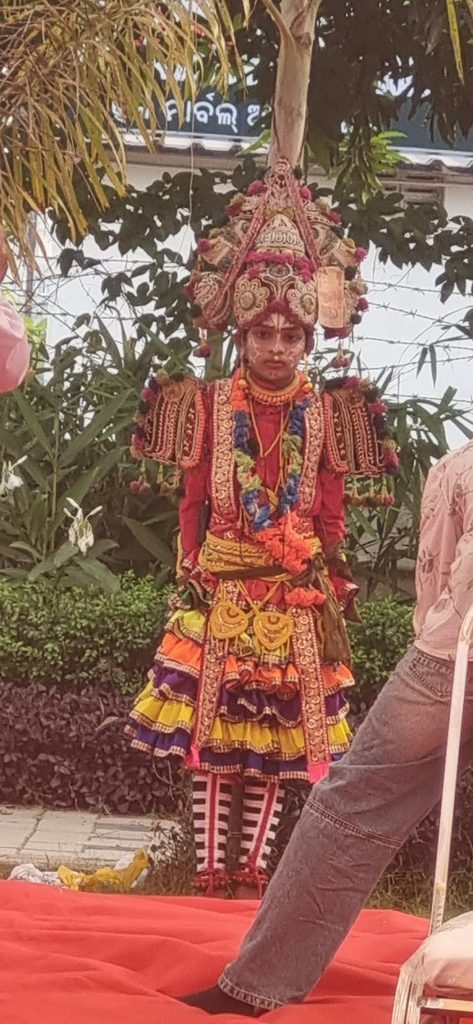
The story moved through the Aranya Danda and Bijayachandi Danda, followed by Sarpa Danda and Agni Danda that’s the infamous Holika’s attempt to kill Prahlada in the fire. Each punishment was another attempt to break his devotion.
We know these scenes from countless versions of the story. But watching them live changes the experience. There are no computer-generated effects, no camera close-ups or dramatic editing. The actor’s body, expression, voice, costume and movement have to create the entire world.
And somehow, they do.
The side characters brought society onto the stage
Something else caught my attention during these episodes. The side characters were not simply there to fill the stage or move the story forward. They seemed to bring little slices of society into the performance.
During the Sarpa Danda episode, for instance, there was a group comprising one wife and two husbands, presented as professional snake charmers who had travelled across the Indian subcontinent. It was an unusual character combination, and it made me curious about the lives and experiences these characters represented.
Then there were the Kandha characters appointed by the demon king. They were portrayed as people willing to take up almost any kind of work in exchange for money.
Their presence brought another dimension to the performance, one of livelihoods, labour and people trying to make a living. These characters made me realise that Prahallada Nataka is not only about gods, demons and a familiar story of devotion. It also creates a social world around that story, bringing different kinds of people, occupations and ways of life onto the stage.
Even the smaller roles have something to tell us.
Hiranyakashipu wasn’t just a villain
Watching Hiranyakashipu performed live made me notice the character rather than just the villain.
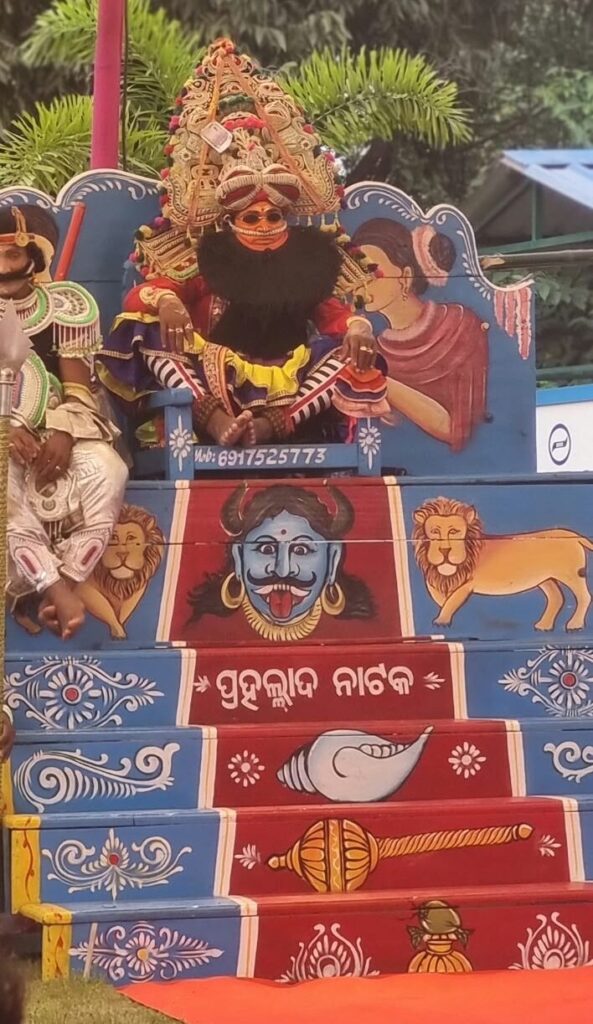
His role is among the most demanding in the performance. The actor moves vigorously up and down the tiered platform, almost in a dance-like manner. Hiranyakashipu does not wear a mask. His face is painted bright red to suggest ferocity. And then there is the moustache made of thick ropes of black thread, twined with golden zari or brocade, it stretches across his cheeks. He wears colourful skirts, elaborate headgear embellished with glittering glass beads, and artificial ornaments and shoulder decorations.
The costume is grand. The crown makes him look larger than life. His dialogues are exaggerated, his movements deliberate, and his voice and mannerisms carry the authority of someone who believes the entire universe should bow before him.
But underneath all that anger is also a father who cannot understand why his own son refuses to accept his power.
Hiranyakashipu wasn’t just a villain. He was the father, the king, the husband.
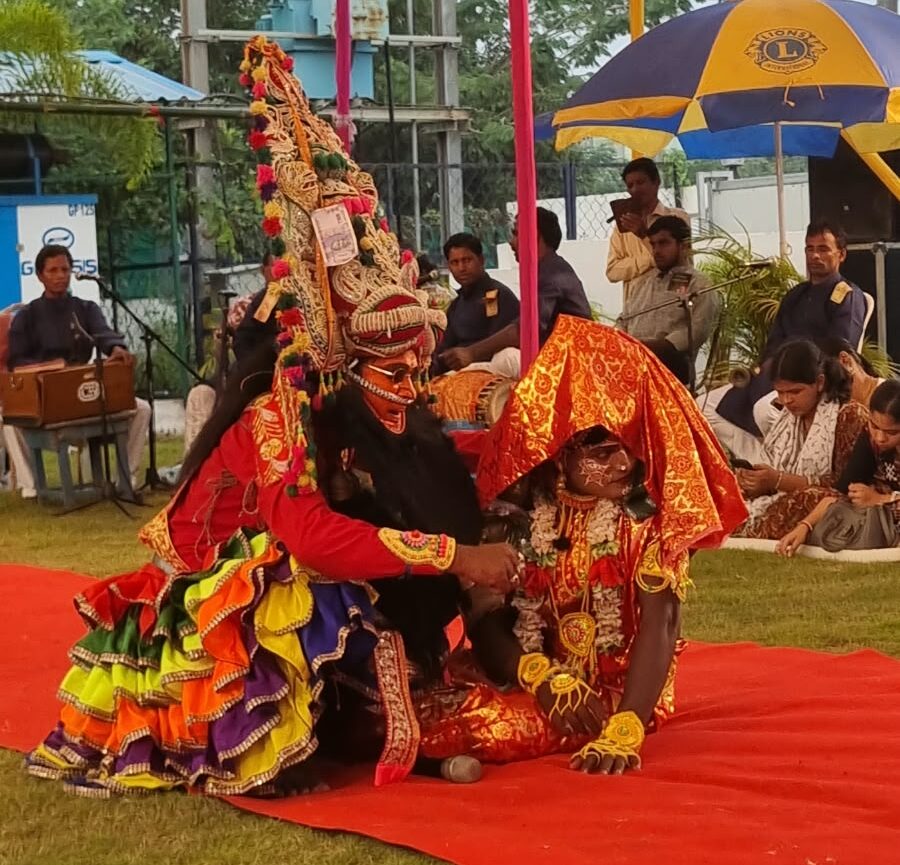
And Prahlada, in contrast, doesn’t need to match his father’s aggression. His strength comes from his stillness and conviction. The visual contrast between the two characters says a lot without needing an explanation.
The mother I hadn’t noticed before, Lilabati
Honestly, for the first time, I found myself paying attention to Lilabati, Prahlada’s mother. (I have known her as Kayaadhu/ Kamala in other versions)
I have seen this story before. We all have. Usually, the mother is shown as the worried woman who watches her child suffer, perhaps sheds a few tears and pleads for his safety.
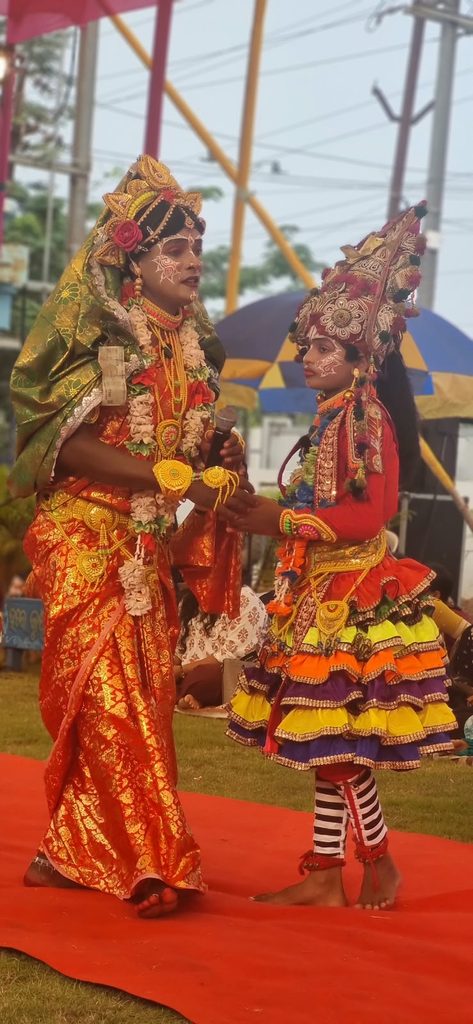
But watching the Nataka made me think about her differently.
When the story unfolds live, you have more time to sit with what she is going through. Imagine being a mother caught between your husband and your child. Your husband is powerful, angry and determined to destroy the very belief that your child holds closest to his heart. And you are watching your child being punished again and again.
The fear feels more human. Her helplessness feels heavier and her love feels more visible. She wasn’t just a side character.
It wasn’t just that Prahlada’s mother was sad. It was more like asking… What must it feel like to watch your child walk into danger, knowing that you may not be able to stop it?
Perhaps that is what live theatre gave me that the animated versions never had. It gave the mother some space to be a mother.
Music is the life of this play
The music deserves its own mention.
Prahallada Nataka has a remarkable repertoire of songs rooted in the classical tradition of Odissi music, with traditional ragas and talas. Published accounts of the form describe a repertoire of around 126 songs, set to 35 ragas and six talas. The musical ensemble traditionally includes instruments such as the mardala, gini, trumpet and harmonium.
The musicians aren’t hidden away somewhere backstage. They are part of the performance. You can see them. You can watch how the music carries the story forward.
There is also something fascinating about the way the songs are introduced, with dhyana shlokas associated with the ragas. For someone used to movies, where music comes and goes according to the scene, this felt completely different.
Here, music is part of the storytelling itself. It doesn’t merely accompany the action. It helps create the atmosphere, carries the emotion and gives the performance its rhythm.
The stage was a character too
Prahallada Nataka is traditionally performed in an open-air setting.
Traditionally, the central mancha is a distinctive seven-stepped wooden platform, traditionally around six feet high. Hiranyakashipu’s throne sits on top. Those seven steps are not merely decoration. They represent his overlordship of the seven worlds.
Opposite the mancha is a temporary pillar, the one we all know is waiting for the final act. I believe it was brought onto the stage during the climax, but we missed that part.
There is something wonderfully simple about this arrangement. A wooden platform. A throne on top. An open performance space. And yet, from these basic elements, an entire kingdom is created.
The grand costumes.
This was probably what held Penguin’s attention for quite some time. The elaborate crowns, jewellery, makeup, colours and sheer scale of the characters were quite something to watch.
Hiranyakashipu looked like the king he was supposed to be. And you could sense that when Narasimha eventually appeared, the transformation would be unlike anything we had seen on a television screen.
Unfortunately, we don’t know. Because we missed Narasimha. We wanted to stay for the climax. We really did. We wanted to see the pillar. We wanted to see Narasimha, Vishnu’s fourth avatar, emerge and slay Hiranyakashipu.
But we missed the fourth part.
And perhaps that is why I am still thinking about Prahallada Nataka. I now have a reason to go back. I want to see that final act. I want to see the transformation.
I want to see the Narasimha mask that, in some villages, is itself worshipped throughout the year and brought out for the performance.
I want Penguin to see it too. Perhaps we will get another chance.
Different from the Narasimha we know so far
On the way home, Penguin and I spoke about the difference between what we had just watched and the animated Narasimha stories we have seen.
The animated versions are spectacular. They bring mythology alive with colour, movement, sound effects and visual effects. Television gives us close-ups, dramatic background music and carefully constructed scenes.
But Prahallada Nataka does something else.
It reminds you that mythology was once carried from generation to generation through people, voices, music, costumes and memory. Along with the communities that gather to watch.
Animation makes mythology spectacular. Live theatre makes these stories human.
On a screen, the camera decides what we see. On stage, we choose where to look. We notice a character in the background, a musician preparing for the next song, a small gesture or an expression that may not be part of the main story.
And perhaps that is what makes the experience so different.
What happens when the audience stops coming?
There is one thought I couldn’t shake off after watching the performance.
This is a tradition that has enthralled audiences for generations. It has survived royal courts, changing times and changing forms of entertainment. But traditions also survive on patronage. And patronage is changing.
Prahallada Nataka lost much of its royal support over time. Today, it depends on the artists, troupes and rural audiences who continue to keep it alive. Published accounts have also documented the decline in its popularity and the challenges performers face in sustaining the tradition.
As television, cinema, digital entertainment and other forms of performance become easier to access, traditional art forms such as Prahallada Nataka can slowly lose the audiences and support they need to survive.
A 150-year-old tradition shouldn’t become something we only read about in books. It needs people to perform it. And it needs people to watch.
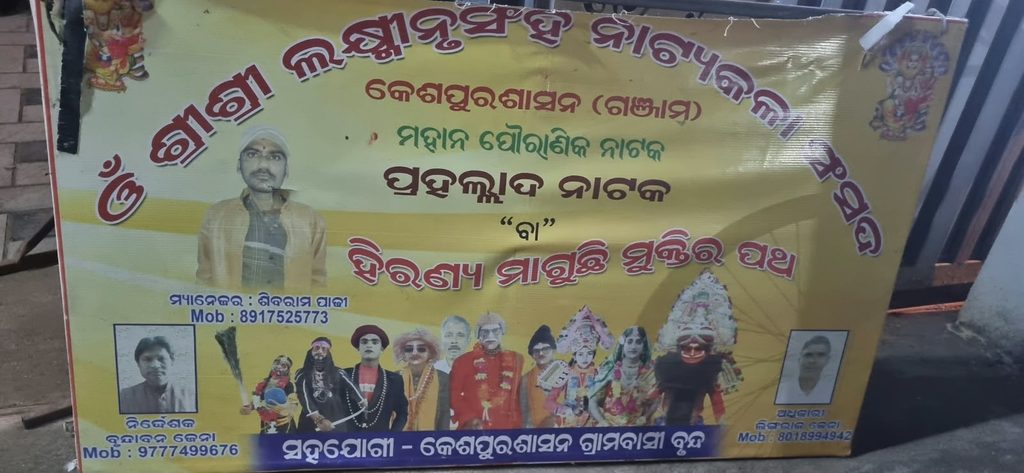
Perhaps that is also why taking Penguin to watch it felt important to me. Not because he needs to remember every detail of Prahlada’s story. But because I want him to know that the stories of our childhood don’t exist only in animated movies and television shows.
Some of them are still being sung, acted, danced and carried by people who learnt them from people before them.
And sometimes, all we need to do is show up and watch.
For now, Penguin and I have seen three parts (or rather 2.5 parts). We are still waiting for the fourth. And perhaps that unfinished ending is not such a bad thing after all. It gives us a reason to go back.
Thanks to Baithak, Odissi and Beyond for bring the play to city. Kudos to your effort.


